Garden room installation on difficult and sloped plots
How we get a garden room onto plots that shouldn't accept one. Crane lifts, hand-carry protocols, panel sizes, and the ground-screw handling for serious slopes.
The single most common reason a homeowner rules themselves out of a garden room isn't planning or budget — it's access. 'You'll never get it down the side of the house.' 'The garden's on three levels.' 'You can't get a lorry within 200 m.' We hear all three regularly, and in ten years of installing across South Devon and the wider South West we've walked away from access on maybe four plots out of several hundred.
This is the working access brief — how we get a garden room onto plots that on paper shouldn't accept one.
The 900 mm side-access rule
The critical dimension is the narrowest point on the route from the road to the garden. If that dimension is 900 mm or more, we can get almost any Arden & Oak build in by hand. If it's under 900 mm, we're into either crane or through-the-house territory.
Every panel we ship is sized to fit through a 900 mm door frame — the widest single component is 850 mm across. This isn't accidental — it's a deliberate constraint on the design system so that hand-carry is always in scope. SIP panels split at joists, roof panels split at rafter lines, glazing arrives glazed but door frames strip to component parts.
Under 900 mm — crane lifts
For plots with side access under 900 mm we crane the panels over the house or a boundary wall. This is a lot less exotic than it sounds — a 26-tonne mobile telescopic crane parked on the road has a 20-25 m working radius, which covers most residential plots comfortably. Half-day hire is £700-950 depending on the region.
Where we've done this in South Devon:
- — 01Salcombe cottage courtyards — Cliff Road, Fore Street, Devon Road. Crane parks on the road, panels lift over the roof line.
- — 02Dartmouth hillside terraces — Above Town, Vicarage Hill. Crane parks on the upper road, drops panels into the lower garden.
- — 03Kingsbridge Fore Street backs — courtyard gardens reached through the shop. Crane over the shop roof.
Through-the-house access
On plots where the garden is reached only through the house (Salcombe cottages, Georgian terraces, some London mews conversions), we protocol-carry through the property. Floor protection is 6 mm laminated hardboard laid over every carpet and floor between front door and rear door. Wall protection is 25 mm foam corner protection at every doorway. Every panel is signed in, moved by a two-person team, and signed off on the way out.
This adds roughly £280-450 to the install day depending on the length of the internal route. Insurance is comprehensive and we haven't had a claim on this route in six years.
Sloped plots — the ground-screw brief
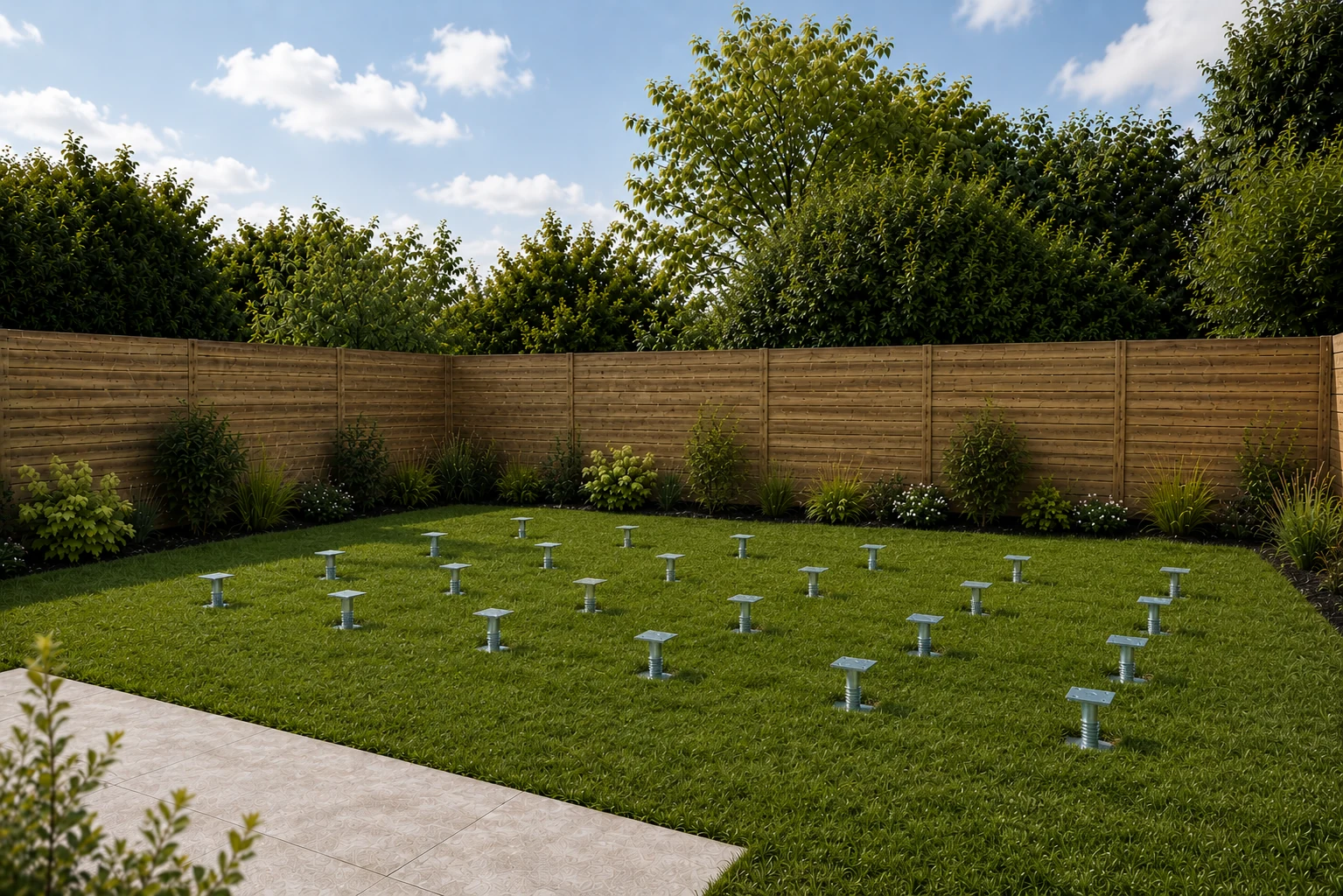
The other end of the difficult-plot conversation is slope. A plot that falls 400 mm or more across the garden isn't practical on a concrete raft — the excavation and level-shuttering work adds a day and £600-900. Ground screws handle any slope up to about 1.2 m of level change without complication.
Above 1.2 m of change we're often into either terracing the plot (adding a retaining wall) or elevating the room onto a steel deck. Both are options, both cost more than a flat-plot install. For a serious slope like a Kingswear cliff-side or a Noss Mayo waterside plot, we route the specification through a structural engineer and the deck spec is priced separately.
Coastal cliff-edge and no-vehicle plots
The extreme edge of the access brief is plots with genuinely no vehicular access at all. We've done a handful of these — a Bantham dune-side plot reached only by foot path, a Cornish coastal-path property, a Devon smallholding down a bridleway. On these we route materials in by tractor-and-trailer over a farm track or, in one case, by mule train (genuinely). It's not efficient, and the install day rate reflects the additional handling, but the buildings still get built.
“The plot the client thinks is impossible is usually the plot that's the most rewarding to build on. The difficulty forces the design to be considered.”— Arden & Oak — install team
What we need at the survey
Every quote we send for a difficult plot follows a site survey — no exceptions. What we're checking:
- — 01Narrowest access dimension, both width and height, and any turn or step.
- — 02Level change across the footprint and along the access route.
- — 03Vehicle proximity — can a 3.5-tonne van park within 50 m, or do we need mule/tractor/crane arrangements?
- — 04Overhead constraints — trees, cables, telephone lines above the crane swing path.
- — 05Ground condition on the plot itself — this determines whether ground screws will reach virgin bearing or need a trial pile.
For town-specific notes on tight-access plots see our Salcombe, Dartmouth, Kingsbridge, Newton Ferrers and Kingswear pages. Or book a consultation — for any plot you're unsure about, a site visit is the fastest way to a yes-or-no.
The slope-specific companion piece — how helical piles handle 200-800 mm of fall.
Almost every Salcombe plot is a difficult-access job.
Yealm-side plots — sloping, narrow-access, well-worth the effort.
Areas we cover most for this brief.
Three of the locations we build in most for the reading above. Every plot gets a site-specific spec conversation.