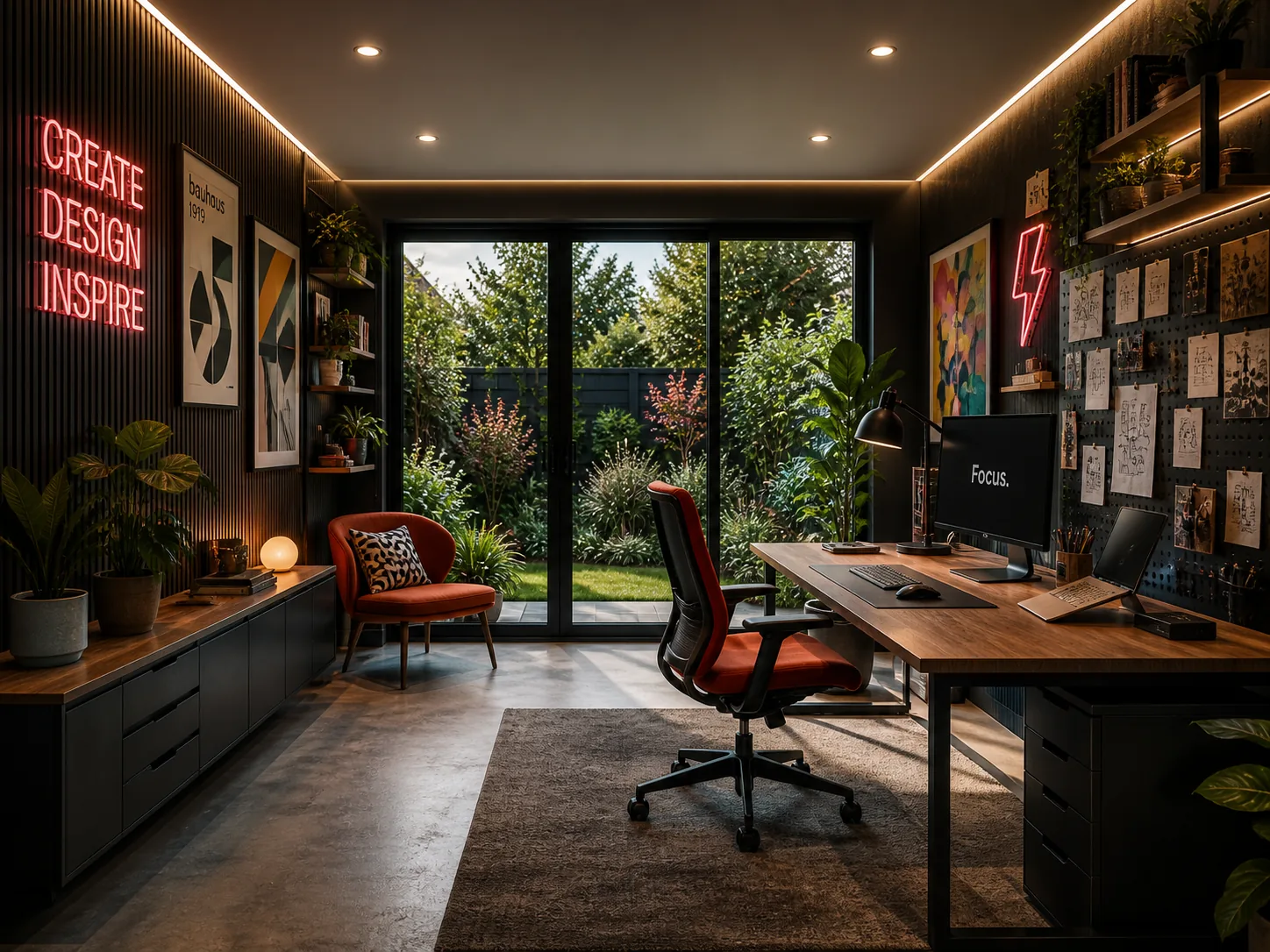
Garden room heating — heat pump vs infrared vs electric radiator
Three heating routes we actually specify, compared on running cost, install cost, comfort profile and the plots each one suits. Real UK numbers.
The heating conversation happens late in most quotes, and it shouldn't. Choosing between a heat pump, an infrared array and a plug-in electric heater has knock-on effects on the electrical spec, the ceiling detail, the interior finish and the year-one running cost — none of which are easy to change once the shell is up. This is the working brief we use with every UK client.
The three options, honestly
Option 1 — reverse-cycle air-source heat pump (2-3 kW split system). Wall-mounted internal head, condenser unit outside on a small bracket. Also cools in summer. Runs at a coefficient of performance (COP) of 3.5-4.0 in mild UK winter conditions, meaning £1 of electricity buys £3.50-4.00 of heat. Install cost £1,600-2,200 fitted.
Option 2 — infrared ceiling panel array. Two to four 400-800 W panels flush-mounted in the ceiling, heating people and surfaces directly rather than heating the air. Instant-on, silent, invisible. Runs at 100% efficiency but no COP multiplier — £1 of electricity buys £1 of heat. Install cost £900-1,400 fitted.
Option 3 — plug-in oil-filled electric radiator. Zero install cost, no design implications. Same efficiency as infrared (100%, no COP) but heats the air rather than the surfaces. Install cost £0-180 depending on whether it's DIY or bought as part of the fit-out.
Running-cost numbers for a working week
Modelled on a well-insulated 4.2 × 3.2 m SIP shell (our standard Forge spec), 8 hours a day, 5 days a week, Feb 2026 electricity price 27p/kWh, external temperature 5°C:
- — 01Heat pump — average draw 0.6 kW over the day. £5.68/week (£147 per heating season).
- — 02Infrared array — average draw 1.4 kW over the day. £15.12/week (£393 per heating season).
- — 03Plug-in radiator — average draw 1.5 kW over the day. £16.20/week (£421 per heating season).
Across a five-year window the heat pump is £1,230 cheaper to run than an infrared array, £1,370 cheaper than a plug-in radiator. The install premium is recovered by year three.
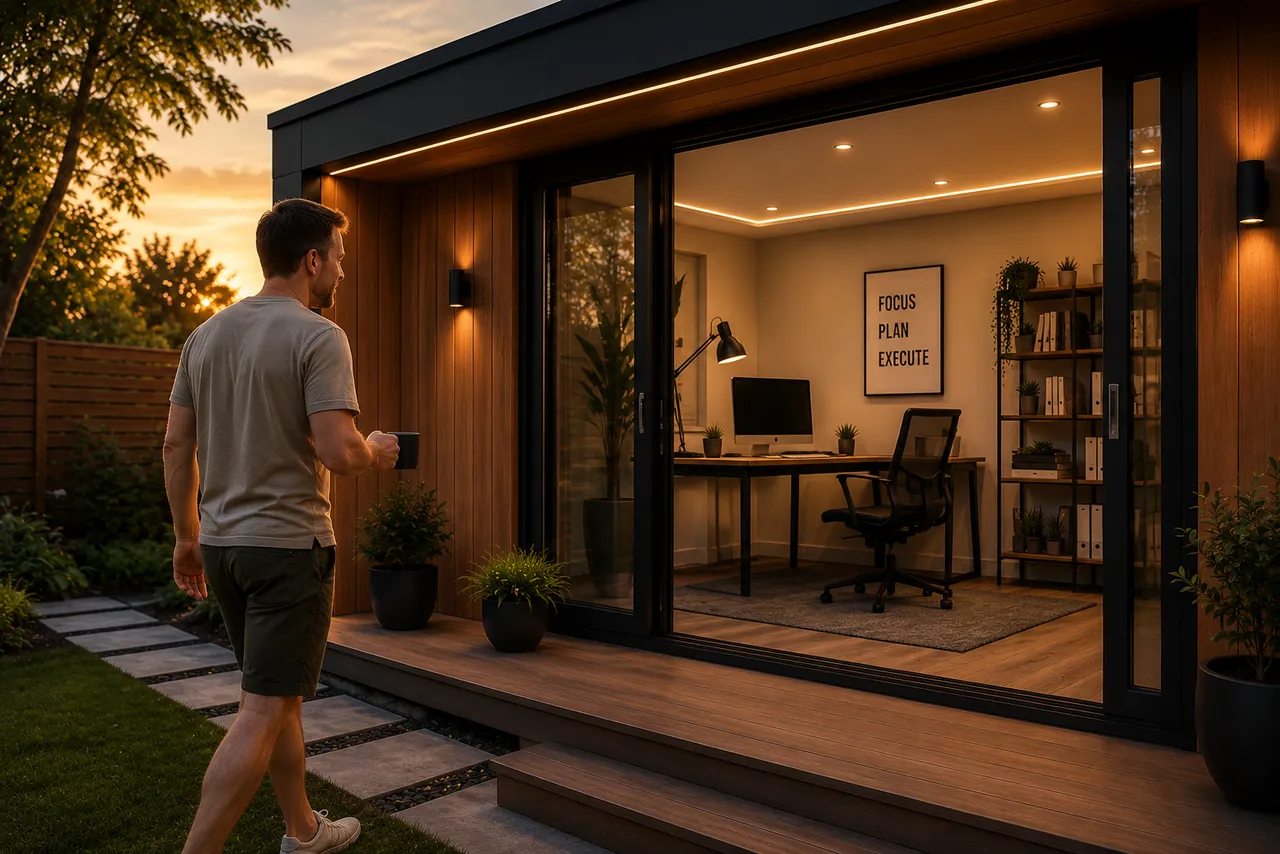
Where each one actually suits
- — 01Heat pump. Any garden room used more than 8 hours a week. Full-time home offices, gyms, cinemas, therapy rooms, studios. The COP multiplier is the reason.
- — 02Infrared. Occasional-use rooms — a garden bar, a hobby workshop, a guest sleepover space. Instant heat when you arrive, no wasted running cost when the room is empty. Also worth it in a north-facing room where the visible heat source (the ceiling panel warming a person directly) is more comfortable than a warm-air system.
- — 03Plug-in radiator. Rooms with no dedicated electrical spec, or clients who genuinely want zero fixed heating and are happy pushing an oil-filled radiator in and out. Rare — we specify this maybe twice a year.
The spec deltas each choice triggers
Heat pump — needs a 20 A dedicated circuit, an external condenser bracket, a 65 mm penetration through the wall for the refrigerant lines, and (for cooling in summer) a condensate drain to a soakaway. All of that is straightforward if it's spec'd at the design stage, expensive to retrofit.
Infrared — needs a dedicated 16 A radial and (usually) a smart thermostat. Panel positions are set at ceiling design because they replace a light fitting or coordinate with track lighting.
Plug-in radiator — no spec impact but needs the standard socket ring uprated to handle a 2 kW continuous load (which is fine on our default 32 A ring, but worth flagging).
“The right answer for a full-time home office is almost always a heat pump. The right answer for a weekend garden bar is almost always infrared. Getting this the wrong way round is where most of the running-cost complaints come from.”— Arden & Oak — design lead
What we spec by default
Every home-office quote we send includes a 2.4 kW reverse-cycle heat pump as standard, mounted at the design stage. Studio, gym, cinema and therapy-room quotes get the same treatment. Bars, workshops, hobby rooms and pool houses get infrared as standard, with heat pump as an upgrade.
For the wider running-cost brief see the winter garden-room running-costs article. For the office spec conversation, see the South Devon office guide.
The wider heating and running-cost picture — this is the equipment-choice companion.
The full home-office spec — heat pump is standard on every one.
The default footprint for the heat-pump spec above.
Areas we cover most for this brief.
Three of the locations we build in most for the reading above. Every plot gets a site-specific spec conversation.