Winter garden rooms — heating, insulation and the real cost of running one year-round
A published breakdown of the real monthly running costs of a well-insulated garden room across a UK winter. Kilowatt maths, heating options compared, and the numbers we see in the field.
'How much does it cost to run in winter?' is the third question every prospective buyer asks, and it's the answer that's hardest to find written honestly anywhere online. Manufacturers post idealised numbers based on lab conditions. Forum threads range from £15/month to £120/month with no shared spec basis. Neither is much help when you're trying to work out whether your Peloton bill is about to double in December.
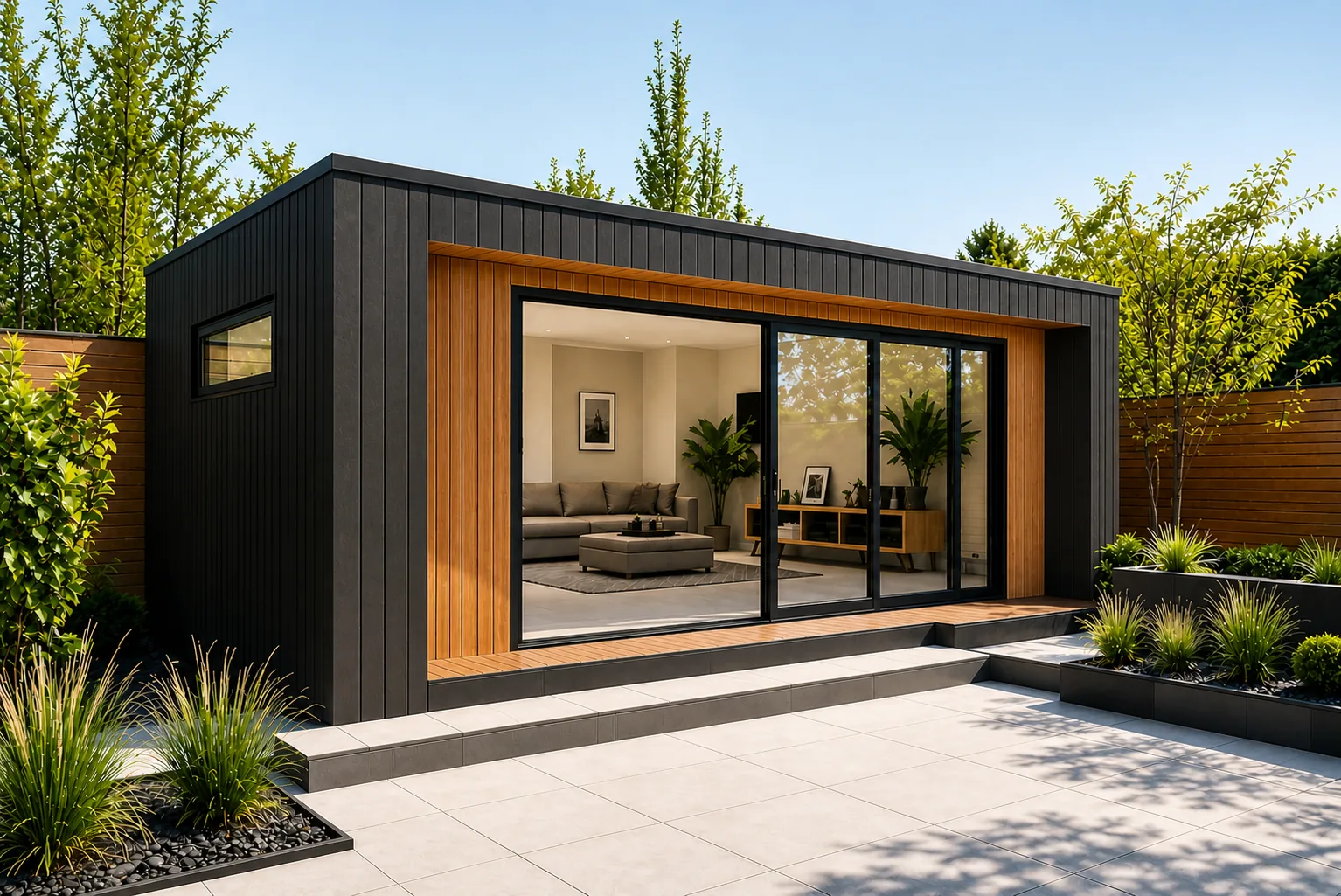
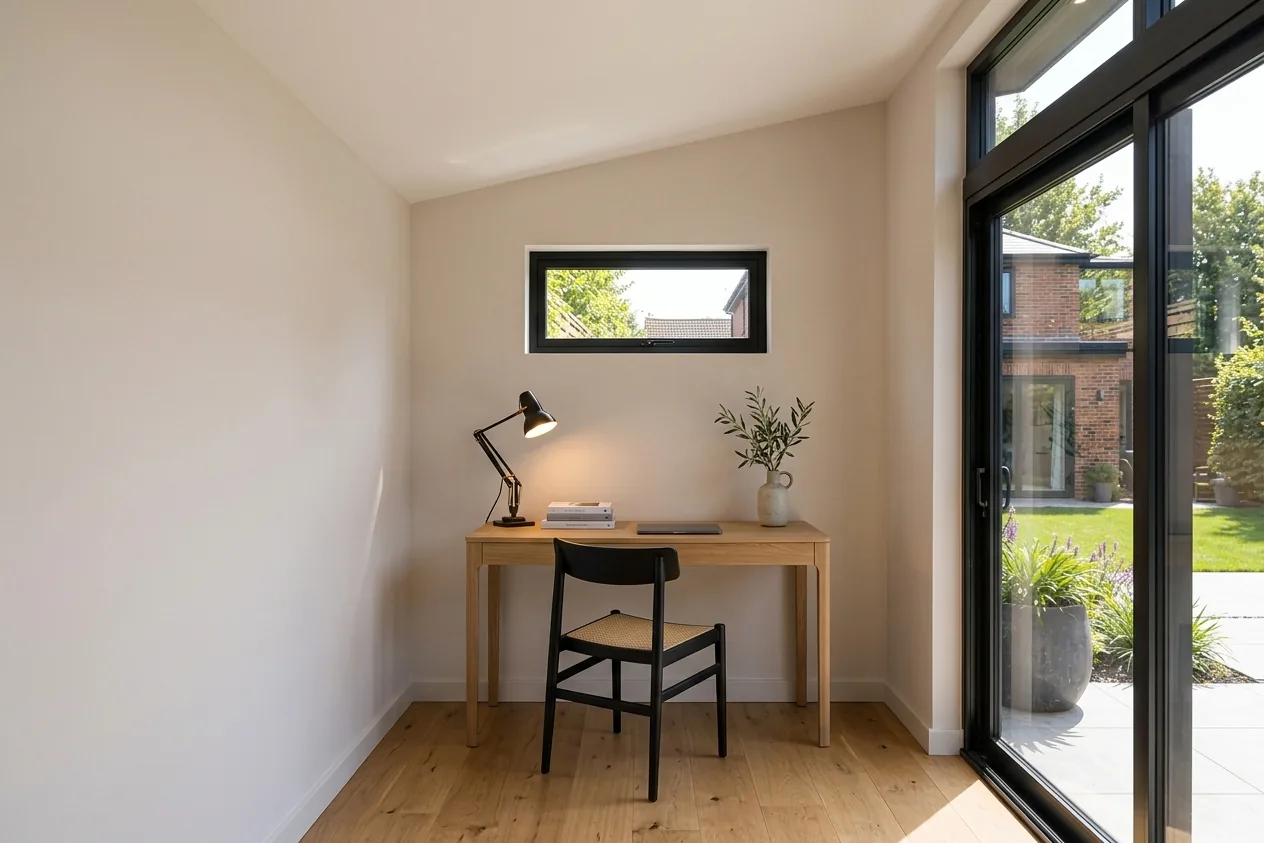
This piece is a published spec-and-numbers breakdown of a real, well-insulated 4.2 × 3.2 m garden office across three UK winters. It's the room our studio lead uses full-time — heating logged, energy prices adjusted to the current cap. If your build spec matches ours, your numbers will land close. If yours is different (thinner walls, single-pane door, resistive heating rather than heat pump), the maths still applies but the numbers scale accordingly.
The spec of the room being measured
- — 01Footprint: 4.2 × 3.2 m external (~13 m² usable internal).
- — 02Wall construction: 142 mm SIP panel (0.20 W/m²K).
- — 03Roof construction: 172 mm SIP panel (0.16 W/m²K).
- — 04Floor: 100 mm PIR insulation on ground-screw-elevated ply base (0.22 W/m²K).
- — 05Glazing: 3 × 2.4 m aluminium sliding door with 4-16-4 argon-filled double-glazed units (1.1 W/m²K centre-pane).
- — 06Air-tightness: taped and sealed to a measured 2.1 m³/(h·m²) at 50 Pa. Better than most new-build houses.
- — 07Heating: 3 kW 'monoblock' air-source heat pump (COP ~3.4 at 5°C outdoor).
The heat-loss maths
For a maintained 20°C internal temperature at a 0°C outdoor temperature — the design condition for a UK winter — the total heat loss through the envelope of this room is roughly 620 W (0.62 kW). That's the steady-state heat loss you have to replace to hold 20°C.
Over an average UK winter day (16 hours occupied, 8 hours setback to 12°C), the daily energy need is roughly 7.5 kWh.
Divided by the heat pump's coefficient of performance (~3.4), that becomes ~2.2 kWh of electricity per day, or ~66 kWh over a 30-day winter month.
At the current UK electricity cap (~£0.27/kWh) that's £17.82 per month in the coldest weeks. In shoulder months (October, March) the number falls to £8–£11 per month.
The actual numbers we've logged
- — 01December 2023: 71 kWh / £19.20 (that year's electricity cap higher — worked out to £24 at spot rates).
- — 02January 2024: 79 kWh / £21.35.
- — 03February 2024: 68 kWh / £18.35.
- — 04December 2024: 65 kWh / £17.55.
- — 05January 2025: 74 kWh / £19.98.
The consistency is the point. A well-insulated garden room in a UK winter runs at £18–£22 per month on a heat pump. That's less than most people spend on Netflix.
Heating options — what we actually recommend
Four heating types get specified in garden rooms across the UK. Here's the honest ranking:
- — 01Air-source heat pump (monoblock). Our default. COP of 3–3.5 in UK winters means you pay for a third of the heat you produce. £2,200–£2,800 installed. Cheapest to run.
- — 02Infrared panels. Silent, low-profile, quick to turn on. But 1:1 conversion (1 kWh in = 1 kWh out), so 3× the running cost of a heat pump. Good for occasional-use rooms; expensive for daily home offices.
- — 03Electric radiator / oil-filled heater. Same 1:1 conversion. Popular because they're cheap to buy (£80–£200), but the extra £30/month adds up.
- — 04Underfloor electric. Comfortable at low ambient temperatures but the response time is slow — you're heating a thermal mass, which is inefficient for a room used intermittently. We only spec it in gym / yoga briefs where continuous 21°C is genuinely wanted.
The three things that actually move the numbers
If you're comparing quotes and one supplier's insulation looks lower than ours, here's what it means in real money:
- — 01Wall thickness: dropping from 142 mm SIP to 90 mm stud-wall adds roughly £8-£12/month to the winter running cost of the same-size room. Multiply by 25 years of ownership.
- — 02Glazing: swapping triple-glazed sliding doors to single-glazed adds £15–£20/month.
- — 03Air-tightness: a stud-wall room built without membrane detailing typically tests 3× leakier than a SIP box. Real-world running cost is 30-40% higher.
“The insulation spec is the running cost. Every quote you compare should list wall U-value, roof U-value and glazing spec — if it doesn't, ask.”— Arden & Oak — studio brief
The bigger picture
A well-insulated 13 m² garden room heated with a heat pump costs less to run over a UK winter than a single-room extension of the same size. The construction is better insulated than most of the house it sits behind, and the volume is small enough that the heat pump barely has to work.
The reason so many older garden rooms have a reputation for being cold and expensive to run isn't fundamental — it's that they were built as garden sheds with a bit of insulation added. Build them the way you'd build a low-energy house and the numbers work out fine, year-round.
The build detail behind the numbers above.
Why 142 mm SIP outperforms 90 mm stud wall at the same running cost.
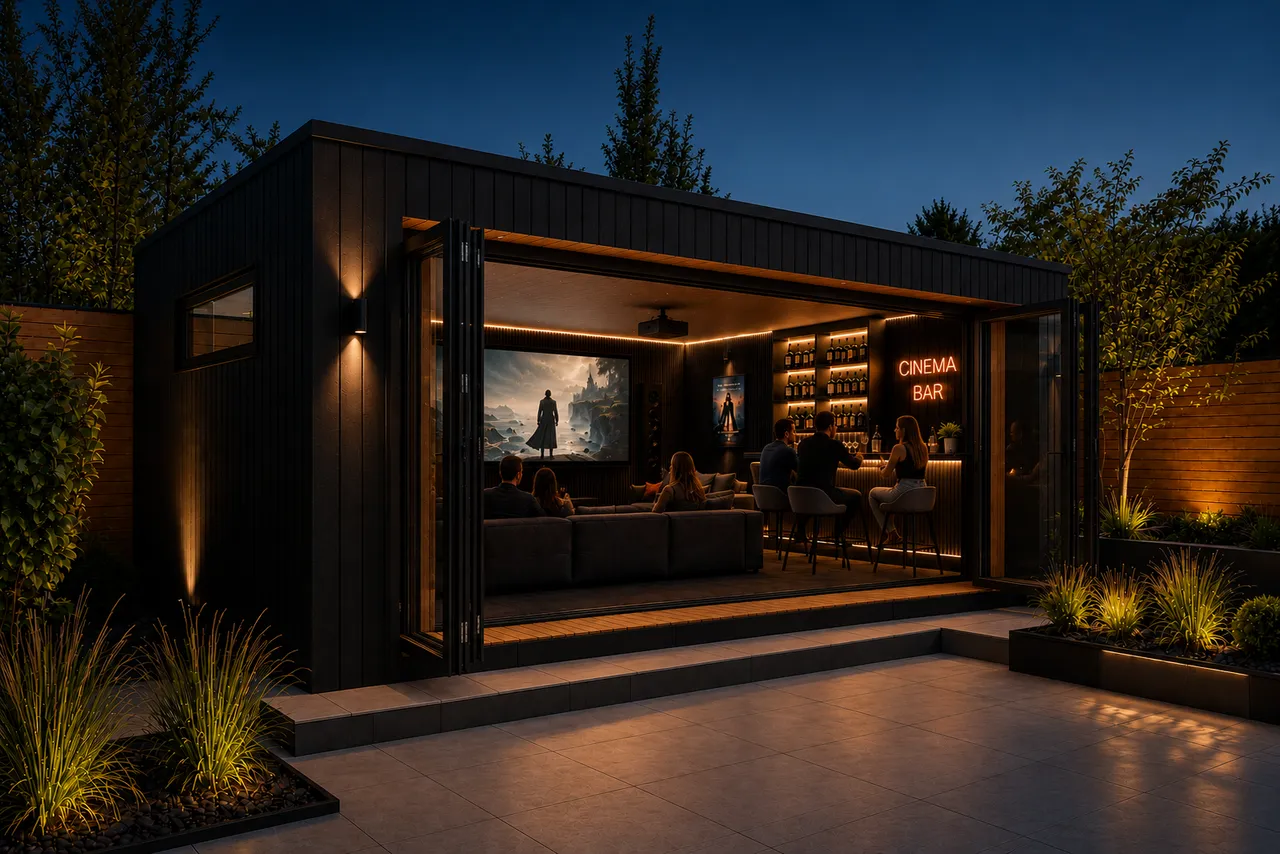
The model in the images — architectural mono-pitch, our year-round default.
Areas we cover most for this brief.
Three of the locations we build in most for the reading above. Every plot gets a site-specific spec conversation.