Anatomy of a year-round garden room: insulation, heating & condensation
The build details that decide whether your room is genuinely usable in January, or a fair-weather hut you avoid for four months a year.
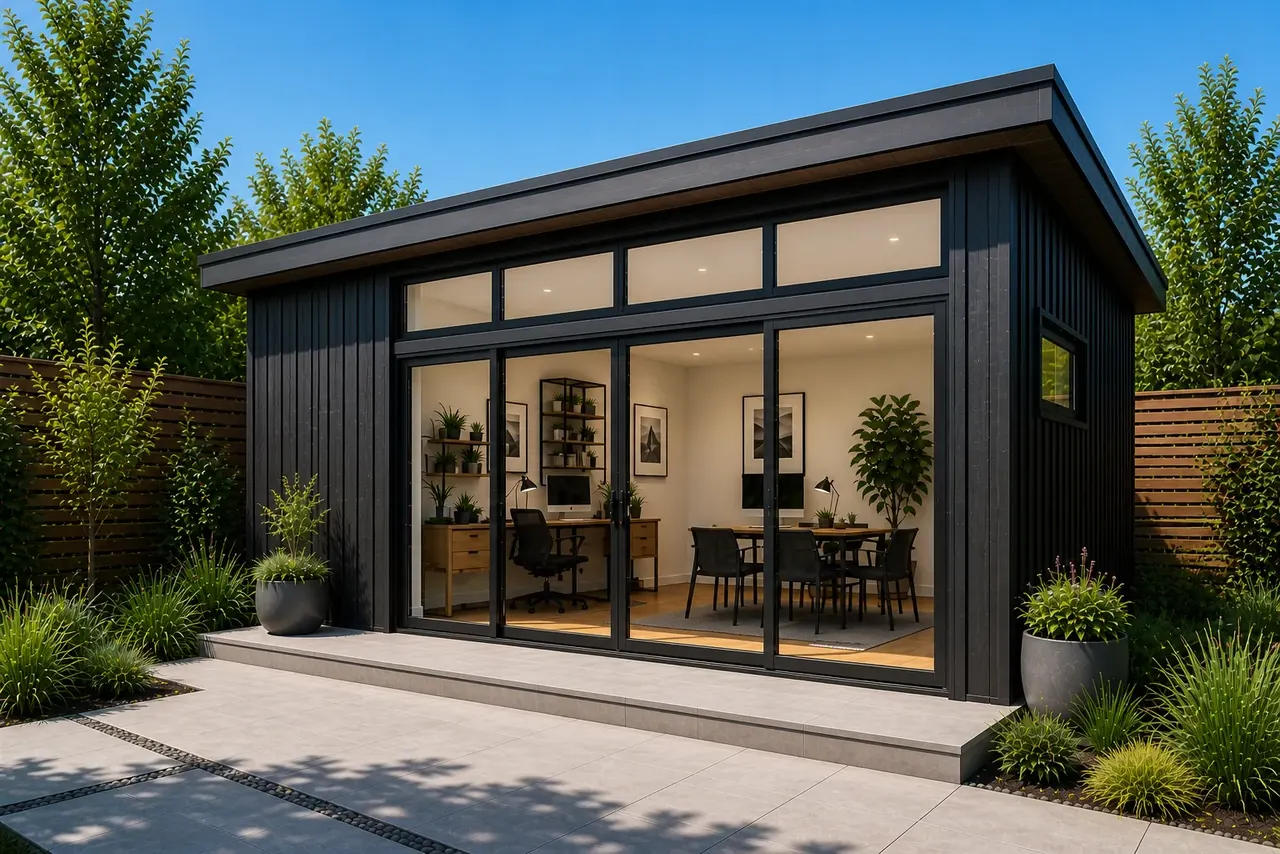
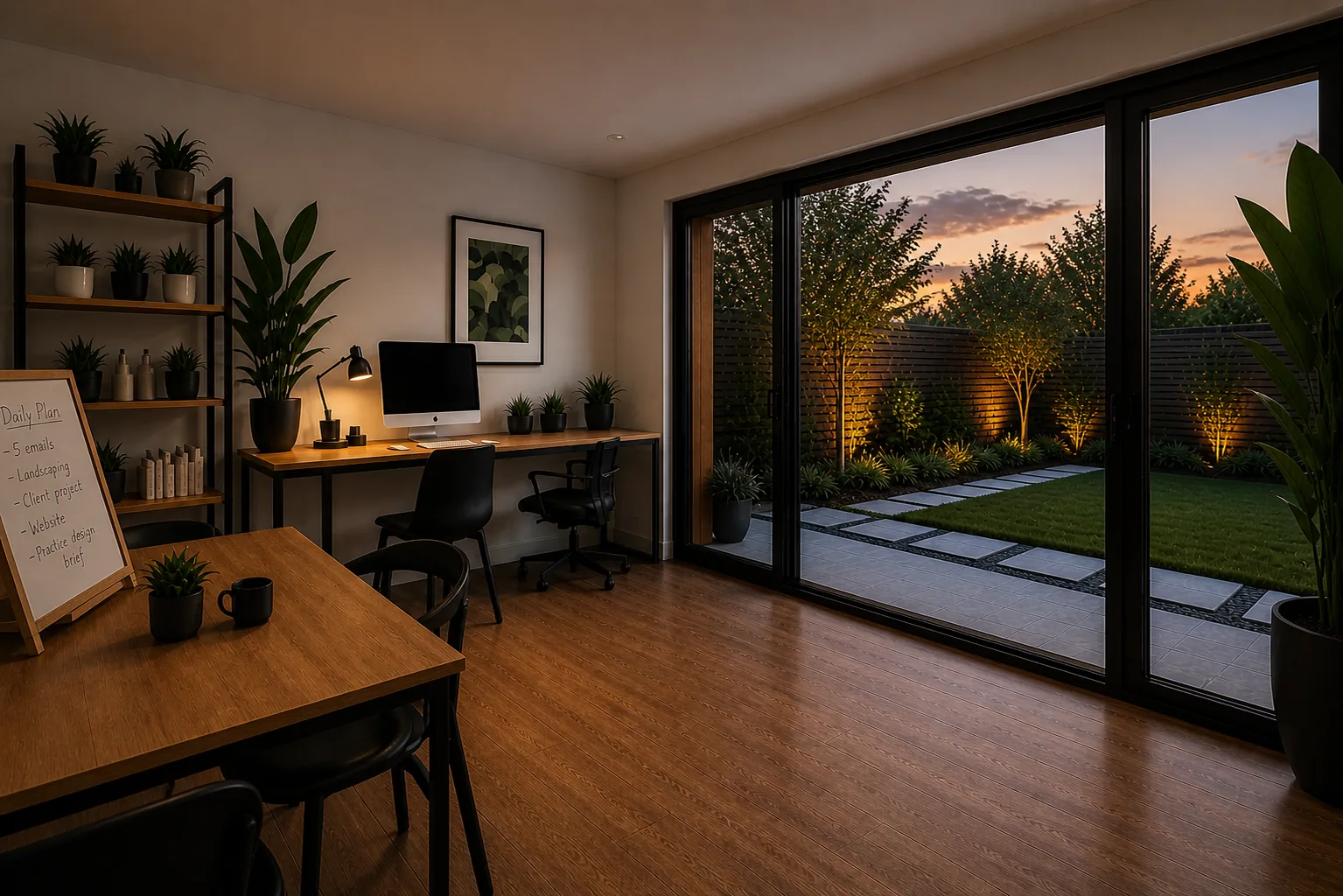
If a garden room only feels comfortable from April to September, the build has been compromised somewhere. There's no exotic technology required to make a small timber-framed building usable through a British winter — just a coherent thermal envelope and a heating system sized to the volume.
The Arden & Oak thermal stack — wall section
- — 01Exterior cladding (composite or timber) — sheds water, contributes ~0.5 U-value.
- — 02Breather membrane — keeps wind-driven rain off the insulation.
- — 03Treated timber frame, 95 × 45 mm studs at 600 mm centres.
- — 04100 mm PIR insulation, full-fill between studs.
- — 05Vapour control layer (the layer everyone forgets — see below).
- — 06Service void with horizontal battens for first-fix cables.
- — 07Plasterboard interior wall.
That stack gives us a wall U-value of around 0.18 W/m²K — better than current Building Regs for new-build domestic walls, in a building that legally doesn't have to comply with them.
Why condensation is the silent killer
Condensation is what causes most premature garden room failures. Warm, moist air from inside the room — your breath, plants, a kettle — hits a cold surface inside the wall and condenses into liquid water, which over years rots the timber frame.
The fix isn't more insulation. It's the vapour control layer (VCL) — a sealed plastic membrane on the warm side of the insulation. It stops the moist interior air ever reaching the cold cavity in the first place. Skipping the VCL is the most common shortcut in budget builds and one of the most expensive to fix retroactively.
Heating — size for volume, not for floor area
A common spec mistake is choosing a heater for the floor area. A 12 m² room with a 2.4 m ceiling is 28.8 m³ — and the heater has to warm all of it. We recommend 100 W per m³ for a well-insulated Arden & Oak build, which means about 3 kW for our standard 12 m² Forge.
- — 01Infrared panel heaters (1.5–2 kW) — silent, no fan, ideal for desk work.
- — 02Electric radiator (2–3 kW thermostatic) — best all-rounder, low cost to run.
- — 03Air-source mini-split — overkill for under 18 m², transformative above it.
- — 04Underfloor electric mat — luxurious for yoga / barefoot use, but slow to come up to temperature.
“If your garden room takes more than 12 minutes to be comfortable from cold on a January morning, the insulation or the heater is undersized. Often both.”