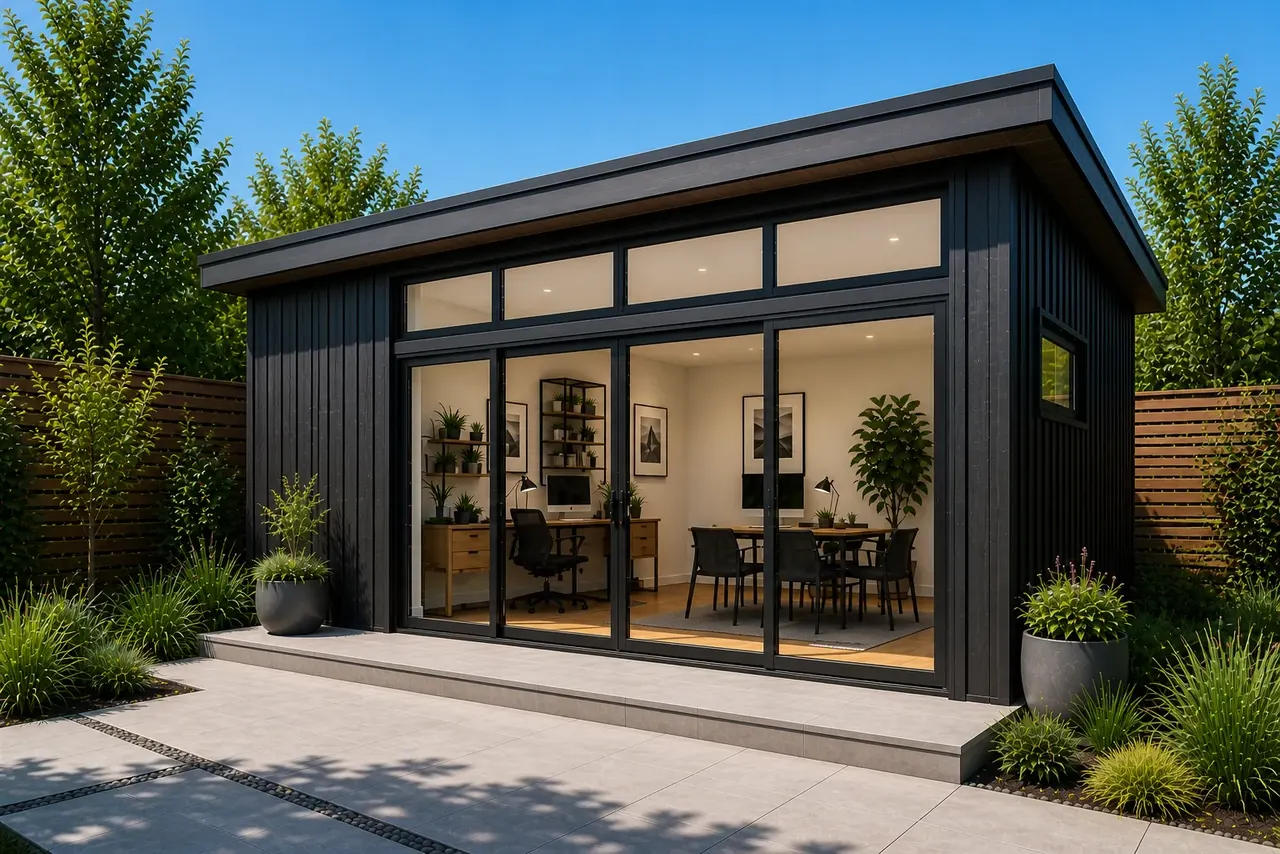
Ground screws vs concrete foundations for a garden room
Why we install every Arden & Oak room on ground screws — and the three scenarios where concrete is still the right answer.
The first quote a homeowner reads about a garden room usually says 'concrete raft foundation' somewhere in the small print. Ours says helical steel ground screws. The switch happens quietly and clients rarely notice until we're on site with a hydraulic drive rather than a mixer, at which point the question is always the same: are these really as good as concrete?
Short answer: for a garden room, they're better on almost every metric. Long answer follows.
What ground screws actually are
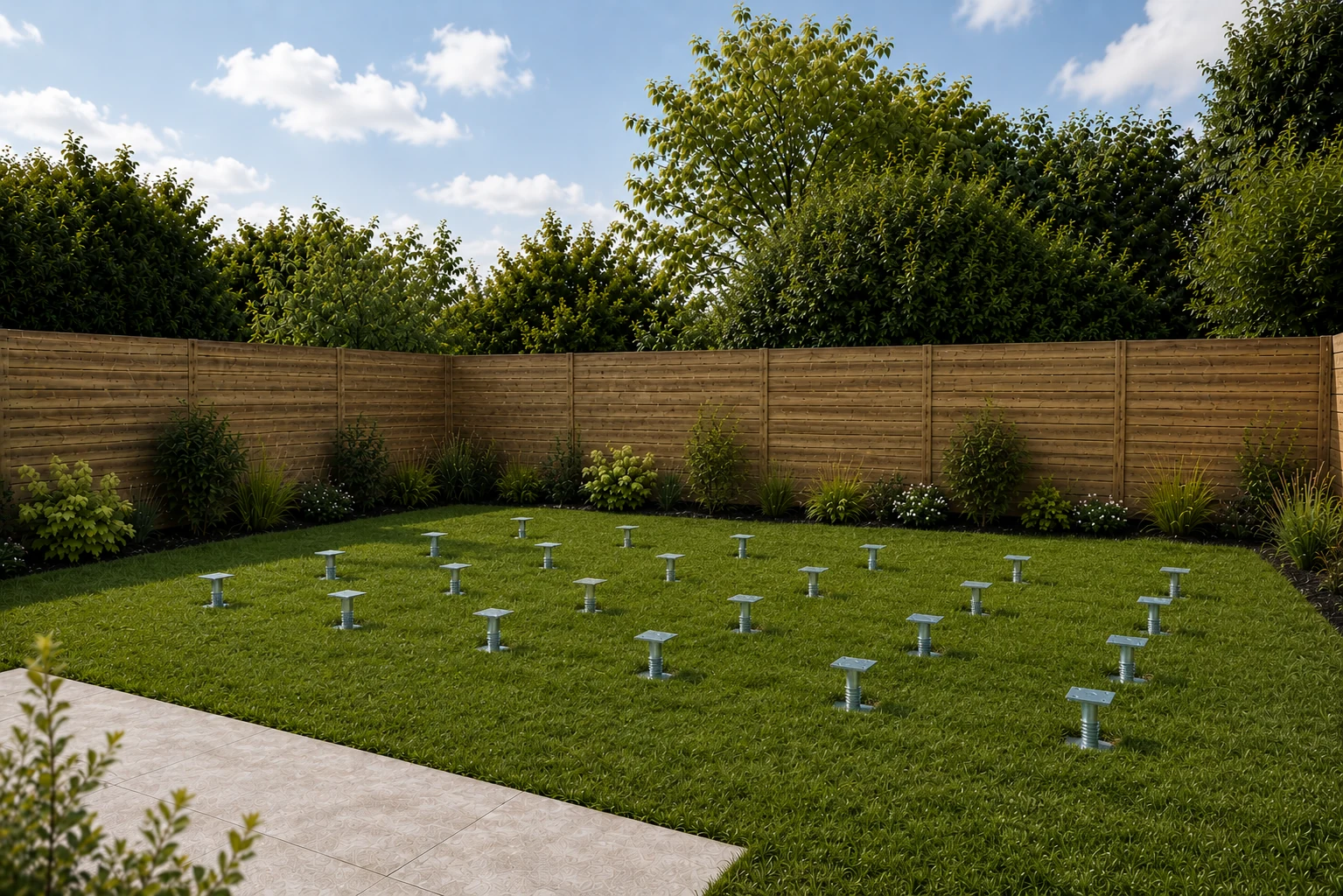
A helical steel ground screw is essentially a giant threaded pile — a hollow galvanised steel shaft with helical flights welded near the tip, driven into the ground with a rotary hydraulic drive on a small tracked machine. The load spec varies with plot conditions, but a typical Arden & Oak garden room sits on 8–14 screws, each 1.6–2.5 m deep depending on soil bearing capacity.
Once driven, each screw's threaded head presents at ground level. A steel U-bracket bolts to it, and the timber base frame of the building fixes to the U-bracket. The building floats 100–150 mm above ground on a level, corrosion-protected steel platform.
The comparison, honestly
Rather than a marketing table, here's what actually matters on a real garden-room build:
- — 01Install time. Ground screws: half a day, occasionally a full day on difficult ground. Concrete raft: 2–3 days of excavation, DPM, shuttering and pour, plus 5–7 days of curing before the building can go on top.
- — 02Ground disruption. Ground screws: no excavation, no spoil, no soakaway to redesign. Concrete: 1.5–2 m³ of clay or subsoil out (depending on slab depth), most of which has to be removed from site.
- — 03Plot recovery. Ground screws can be unscrewed and the plot returns to lawn in a day. A concrete slab is there forever — an unsellable-house issue if a future owner ever wants the garden back.
- — 04Level accuracy on slopes. Ground screws can be terminated to any exact height (they're cut to length after driving), so a plot that falls 400 mm across the footprint is trivially levelled. A concrete raft needs stepped shuttering on a slope, which adds a day and £600–900 of labour.
- — 05Cost. Comparable on a small footprint; ground screws are typically £400–£700 cheaper on a larger build once excavation and soil disposal are priced honestly.
- — 06Load capacity. A single-screw design load is 25–40 kN. A typical Arden & Oak garden room weighs 3–5 tonnes. We deliberately over-specify — the screws under a Forge could support a small car.
- — 07Structural warranty. Both come with a 25-year structural guarantee from the foundation manufacturer. Ground screws are actually more forgiving on shifting ground because each screw acts as an independent pile.
The three times we still specify concrete
We won't pretend ground screws are universally right. There are three scenarios where we quote a concrete slab instead — and we'll tell you upfront if your plot's in one:
- — 01Made-up ground under 2 m depth. If a plot sits on former builder's rubble, garden waste or heavily reworked soil (common on urban terrace gardens from the 1970s and 1980s), ground screws may not reach virgin bearing strata. We'll test with a trial pile; if it fails, we quote a concrete raft.
- — 02Very tight urban plots. Access smaller than 0.9 m makes hydraulic-drive machinery difficult to bring in. In these cases we'll sometimes hand-mix a concrete pad instead. It's rare — but Islington basement gardens qualify.
- — 03Client preference on new-build plots. Some clients on new builds simply prefer the psychological reassurance of a concrete slab, and we'll happily quote it. It's a genuinely valid preference, and the price difference is small enough that it's not worth arguing.
The environmental note
Concrete production is one of the largest single sources of embodied carbon in construction — around 300 kg CO₂ per m³. A typical garden-room slab is 1.5–2 m³, so we're talking about 450–600 kg CO₂ per foundation. Ground screws are galvanised steel; the embodied carbon of the screw set for a comparable build is roughly a third of the concrete equivalent, and the screws are reclaimable if the building is ever removed.
“In twelve years of installing ground screws under garden rooms, we've had zero settlement claims. In the four years before that when we still poured slabs, we had two.”— Arden & Oak — install team
The bottom line
For 98% of the gardens we work in — south-coast sandy soils, London clay, chalk downland, Cotswold limestone, coastal sand-and-shingle — ground screws are the right foundation. Fewer disruption days, no soakaway redesign, better level accuracy on sloping plots, and a considerably lower carbon footprint. We include them as standard, no upsell, no small print.
Areas we cover most for this brief.
Three of the locations we build in most for the reading above. Every plot gets a site-specific spec conversation.