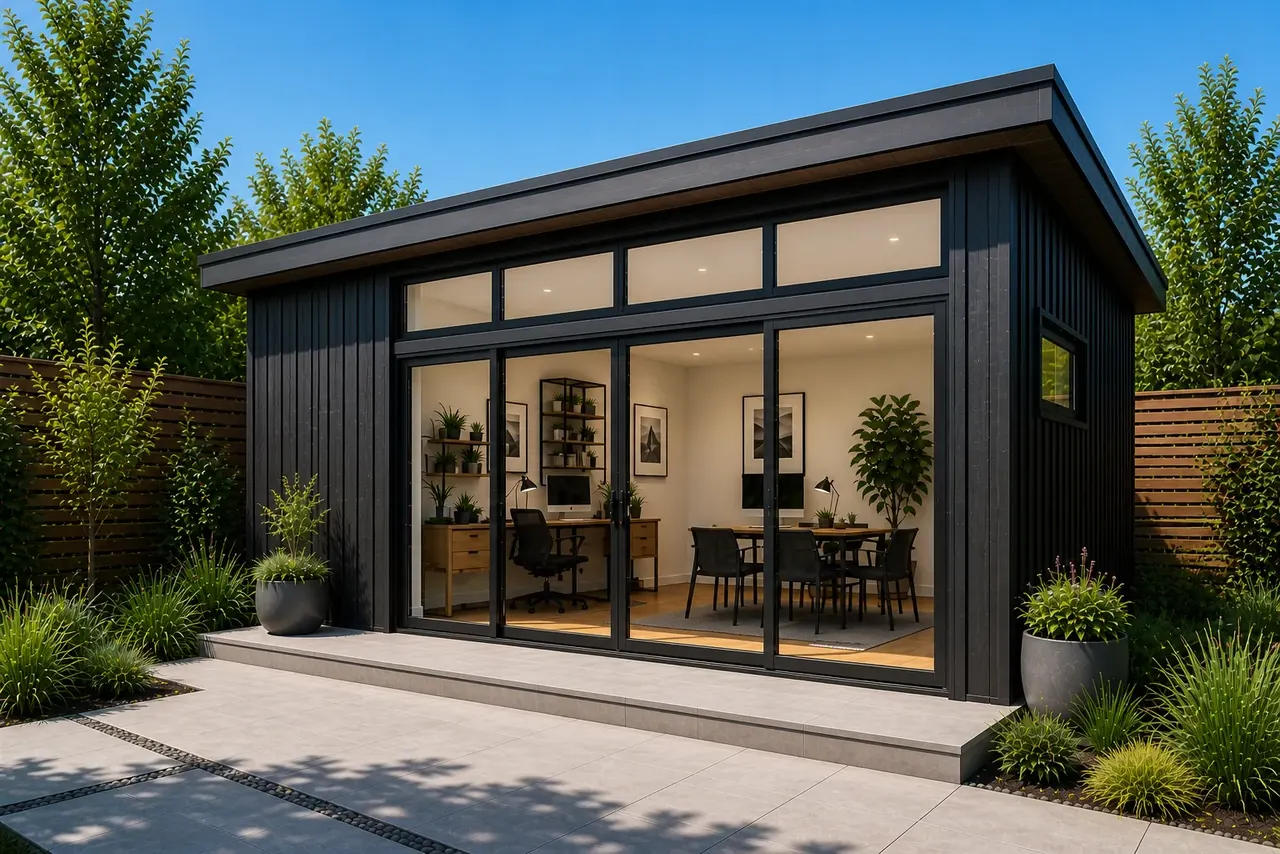
Ground screws for sloping gardens
Why helical steel piles are the sensible foundation for any plot that isn't dead flat — and the technical detail that separates a good ground-screw install from a bad one.
Roughly 90% of the plots we work on across South Devon aren't flat. The estuary villages step down toward water. The coastal towns sit on hillsides. Even the working plots in Kingsbridge, Totnes and the wider South Hams villages usually have some fall across the garden. This is the reason we install every Arden & Oak room on helical steel ground screws rather than a concrete raft.
Why concrete struggles on slopes
A concrete raft needs a level bearing. On a plot that falls 400 mm across the footprint, you need to either dig down at the uphill end (creating spoil, a soakaway problem, and often a retaining wall requirement) or step the shuttering (creating a stepped slab with two levels). Both add £600-1,200 of labour and time, and neither looks tidy where the slab meets the ground on the uphill side.
Serious slope — 800 mm+ — pushes the concrete conversation into engineered-foundation territory, which is when the cost of the foundation starts to approach the cost of the building. It's not proportionate for a garden room.
How ground screws handle it
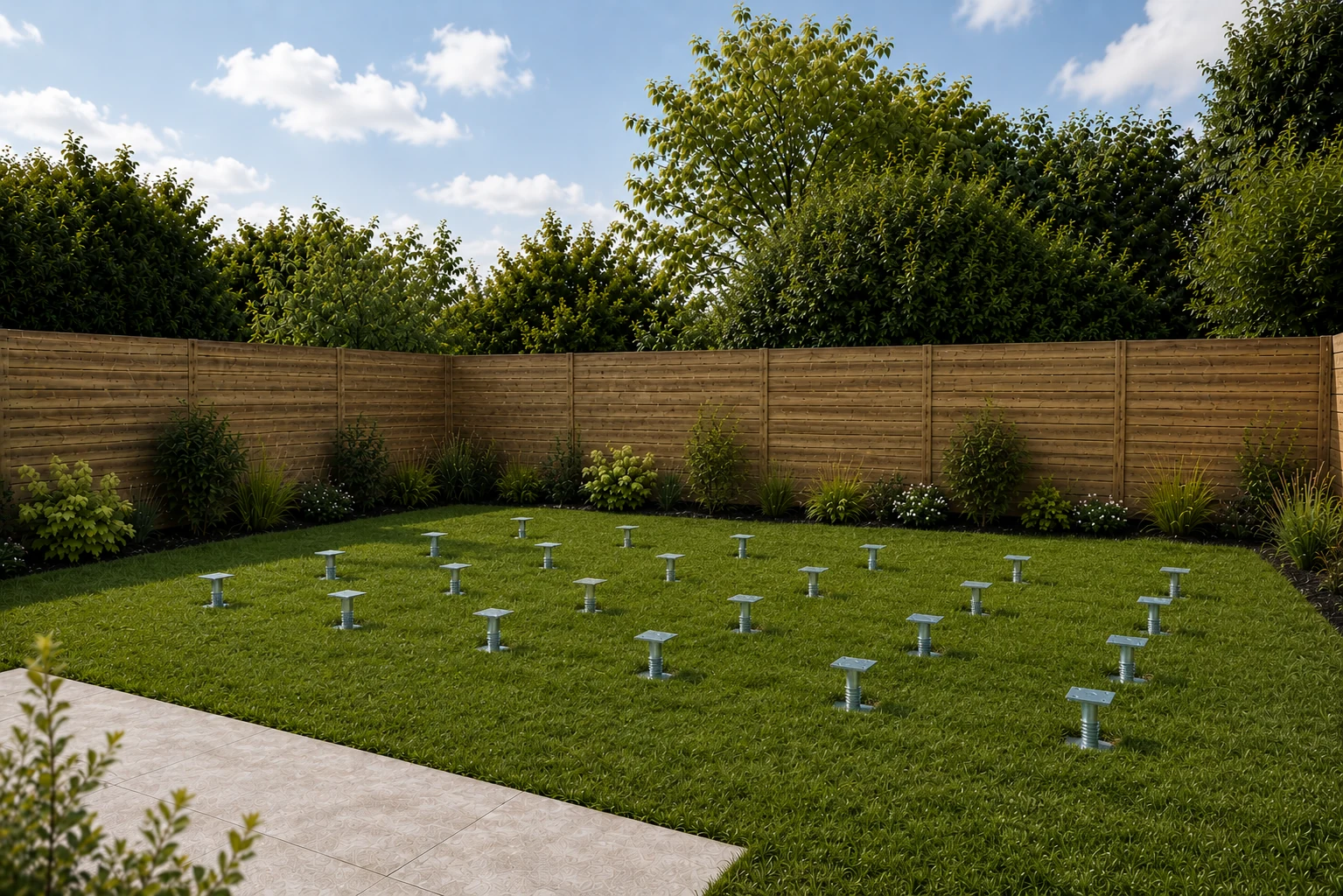
A helical steel ground screw is driven into the ground with a rotary hydraulic drive on a small tracked machine. Each screw is 1.6-2.5 m long — the length varies with soil bearing capacity and how deep we need to go to reach virgin ground. Once installed, each screw is cut on site to whatever exact height the levelling brief calls for.
On a plot that falls 400 mm across the footprint, the uphill screws are cut 400 mm shorter than the downhill screws. The building sits perfectly level on the resulting steel platform, elevated 100-150 mm above ground. No excavation, no spoil, no soakaway redesign, no retaining wall.
The technical detail on serious slopes
For plots with more than 600 mm of fall we do three things differently:
- — 01Longer screws on the downhill posts. The screw needs to be embedded to the same effective depth as the uphill screws to give a consistent bearing across the platform.
- — 02Steel angle-bracket reinforcement on the base frame. The elevated timber base frame carries more shear load on a serious slope; a hot-dipped galvanised angle bracket at every screw head handles it.
- — 03Additional intermediate screws. Standard install is 8-14 screws for a 4 × 3 m building. On a serious slope we'll often add 2-4 more screws to distribute the load.
Access and machinery
The tracked drive machine we use fits through a 900 mm access gap. On plots tighter than that (a Salcombe cottage courtyard, for example) we hand-drive smaller screws with a hydraulic handheld — slower, more expensive per screw, but it means we can get onto plots that would rule out any conventional foundation. Access is one of the first things we check at the site survey stage.
“The tighter the plot and the steeper the slope, the more sense ground screws make. Almost every South Devon estuary village plot we've worked on has been on serious levels — the alternative would be excavating half the garden.”— Arden & Oak — install team
For town-specific notes on sloping plots see our Newton Ferrers, Noss Mayo, Kingswear, Dittisham, Dartmouth and East Portlemouth pages. Ground screws are standard in every quotation we send — no upsell, no small print.
The wider technical comparison — this is the sloping-plot companion piece.
Almost every Yealm plot slopes toward the water.
Mid-Dart village where the ground-screw brief is standard.
Areas we cover most for this brief.
Three of the locations we build in most for the reading above. Every plot gets a site-specific spec conversation.