Therapy and consulting room garden rooms — privacy, spec and the business-use question
The garden room built for one-to-one consulting work. Sound privacy between the room and the house, separate access, waiting area, and the business-use tax picture.
The garden-room therapy-room brief has quietly grown into one of our most consistent categories. Counsellors, psychotherapists, hypnotherapists, physios, osteopaths, coaches, mediators, financial advisors — a whole cluster of independent professionals who need a properly private, professional space that isn't in the family kitchen. Getting the brief right is straightforward once you know what to look for.
Sound privacy — the non-negotiable
The single most important spec choice for a therapy room is sound isolation between the room and the house. A client shouldn't be able to hear a family television from the therapy chair, and a therapist shouldn't be able to hear the client's session from the kitchen. Both scenarios undermine the confidence in the space.
Our default therapy-spec wall build-up:
- — 01142 mm SIP shell as standard, provides an STC of roughly 40 unfitted.
- — 02Interior lined in 15 mm acoustic plasterboard on resilient bars — pushes STC to 48-50. Enough that a raised voice inside is not audible outside at 3 m.
- — 03Acoustic door set (solid-core door, seal-lined frame, drop-seal at threshold). Standard doors leak sound; therapy doors don't.
- — 04MVHR ventilation instead of trickle vents. Trickle vents are sound-leakage paths; MVHR ducts are attenuated.
Access and the waiting area
A professional therapy room needs a client to be able to arrive, wait briefly, be seen, and leave — without ever entering the house. This is one of the sharpest differences between a garden-room therapy space and a spare-room home office.
The moves we design in on every therapy-room brief:
- — 01Side-gate access from the front driveway to the garden — sometimes a new gate, sometimes a redesigned existing one. Bypass the house entirely.
- — 02A small covered waiting area outside the therapy-room door — usually a pergola-covered spot with a bench, discrete, sheltered. Clients can arrive slightly early without being awkward.
- — 03Clear signage — house name or number, and a small brass 'please knock' plate near the therapy-room door.
- — 04Discreet planting between the therapy-room approach and the main house — screens both directions.
Interior design for a therapy brief
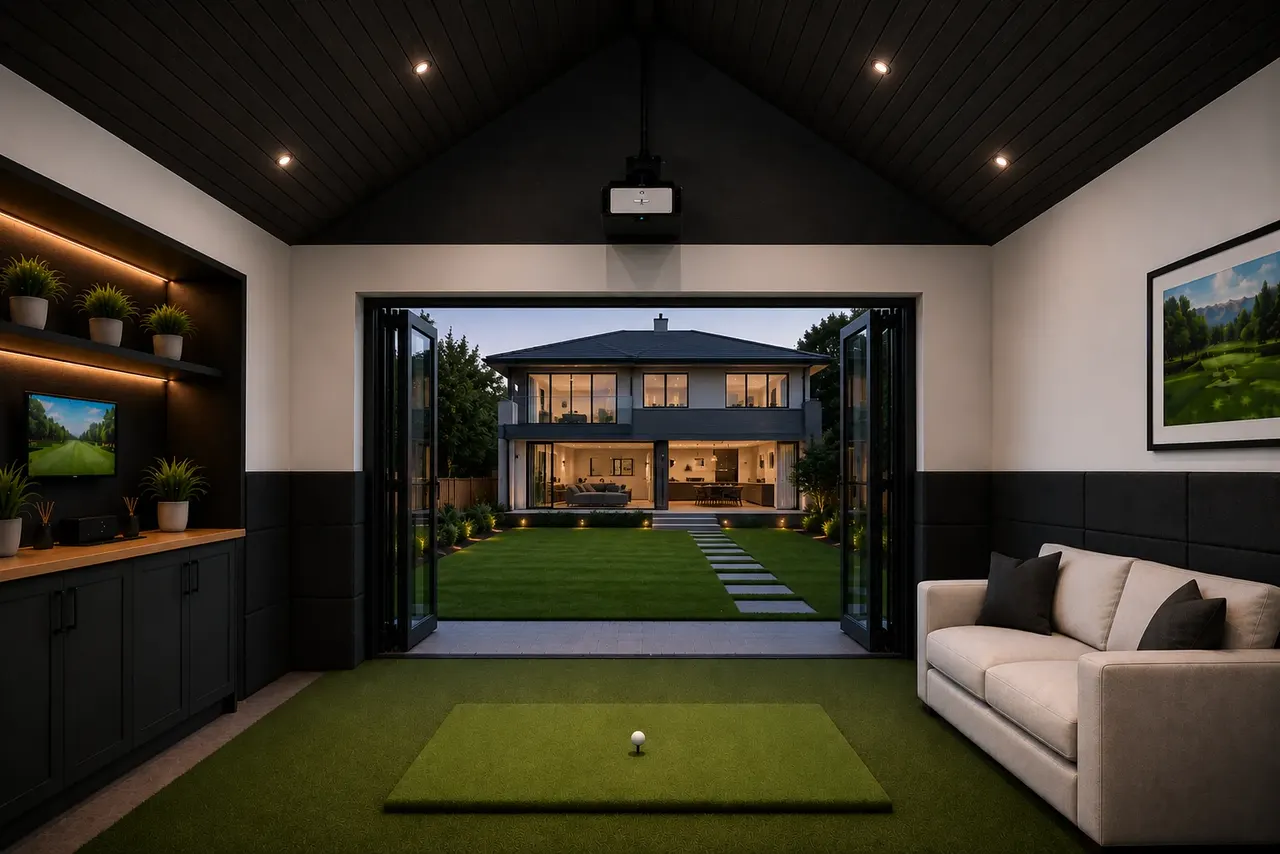
The therapy-room interior is deliberately understated. Standard fit-out:
- — 01Warm ambient lighting on a dimmer (2700K, 60-70% for a session).
- — 02One task light — usually a floor lamp — for note-taking without overhead glare.
- — 03Neutral wall finish — sanded natural birch ply or a soft off-white paint. Never bright colours, never patterned wallpaper.
- — 04One quality armchair for the client, one for the therapist, a small side table, and (usually) a discrete bookshelf.
- — 05No visible clock facing the client — clocks facing away, or placed on the therapist's side.
For anything requiring a couch (hypnotherapy, some psychotherapy modalities, physio), we spec a compact 1900 × 700 mm couch position with 500 mm circulation on both long sides. The 5.0 × 4.0 m external footprint accommodates this comfortably.
The tax picture — briefly
A garden room used exclusively for a therapy practice is treated by HMRC as business premises. The tax picture:
- — 01If bought through a limited company, VAT is reclaimable (£3,000-4,500 back on a typical build).
- — 02Business rates may apply — but for a therapy room under 25 m², small business rate relief typically zeroes the bill in practice.
- — 03Capital allowances are claimable on the fit-out (fixtures, lighting, ventilation) but not the structural shell.
- — 04Council tax on the main house is unaffected unless the garden room is genuinely commercial usage.
For the full tax walkthrough see the dedicated garden-office tax article — most of it applies directly. We'd always recommend a five-minute call with your accountant before signing off — the numbers can move £2-4k either way depending on your specific setup.
“A well-built therapy room pays for itself inside eighteen months against a rented consulting-room lease. Independent therapists don't need a rented practice — they need a properly designed room at home.”— Arden & Oak — design lead
What it costs
A therapy-spec garden room (4.2 × 3.2 m, acoustic interior lining, acoustic door set, MVHR, discreet exterior lighting, side-gate access design) sits at £22,500-25,500 all-in. Somewhat more if the site design needs a pergola waiting area or replanted access screen.
The natural therapy-room footprint — quiet volume, considered proportions.
The tax walkthrough — most of it applies to a therapy-room brief.
The infrastructure spec — the same standards apply here.
Areas we cover most for this brief.
Three of the locations we build in most for the reading above. Every plot gets a site-specific spec conversation.