Garden rooms in the South Downs, New Forest and coastal Hampshire — what changes
Regional design + planning brief for buyers in Hampshire, West Sussex, East Sussex and the Isle of Wight. AONB rules, coastal cladding and the material choices that survive the Solent salt.
Every county in the South of England has its own architectural sensibility, but Hampshire and Sussex sit apart from the rest of the region for two reasons: they're the two counties with the largest AONB and National Park footprints, and they're where we design most often for the salt-air coastline. Both of those things change what we build.
This piece is written for prospective buyers in Winchester, Southampton, Portsmouth, Chichester, Brighton, Hove, Lewes, Eastbourne, Lymington, and the Isle of Wight. If you're on a rural or coastal plot inside the South Downs National Park, the New Forest National Park, or the High Weald AONB, some of what follows is directly relevant. If you're on a suburban plot in Basingstoke or Farnborough it probably isn't — but the coastal cladding notes still apply if you're near the Solent.
The rules that actually change
Standard permitted-development rules for outbuildings — 2.5 m eaves height if within 2 m of a boundary, 3.0 m for a flat roof away from the boundary, 4.0 m for a dual-pitched roof, and a maximum footprint that (broadly) can't exceed 50% of the garden — apply across most of England. Two things override them on the plots we're talking about here:
- — 01National Park designation (South Downs, New Forest). Volumes are tighter. Any outbuilding at the side of the property loses permitted-development rights entirely, and dual-pitched-roof allowances drop from 4.0 m to 2.5 m within 2 m of a boundary.
- — 02AONB designation (High Weald, Chichester Harbour). The volume rules are the same as standard PD, but design officers pay far closer attention to materials and profiles. A shiny composite cladding that would be waved through in Southampton will get politely rejected in Midhurst.
- — 03Conservation-area status (Rye, Chichester, Lewes, Winchester cathedral quarter). This one bites hardest — some conservation areas remove PD rights entirely for outbuildings visible from a public highway. If you're in one, get pre-application advice before designing anything.
Cladding for the salt-air coastline
The Solent-facing stretch — Portsmouth, Gosport, Lymington, and across to the Isle of Wight — has weather that eats standard timber cladding. Southerly winds carry salt inland by up to two miles, and the freeze-thaw cycles combined with UV exposure will strip an untreated softwood cladding of its finish inside three winters.
Two cladding choices we specify almost by default on coastal Hampshire, Sussex and IoW plots:
- — 01Charred cedar (shou sugi ban). The charring process closes the wood cells and produces a carbon layer that's naturally resistant to salt, UV and fungal attack. Maintenance is a light wipe every few years. The dark colour sits well against the coastal palette.
- — 02Thermo-treated ash. European ash cooked at low temperature until the sugars caramelise — same durability benefits as charred cedar with a lighter tobacco-brown tone. We use this a lot in Hampshire.
We'd generally steer away from natural western red cedar directly on the coast (it silvers unevenly under salt exposure) and painted timbers below the tree-line (they need repainting every 4-5 years to hold up against the wind).
Design language for the AONB
AONB and National Park design officers aren't trying to stop you building. They're trying to stop shiny things appearing on hillsides. If your garden room reads as a considered, quiet building in natural materials, you'll usually pass with minimal fuss. If it reads as a bright box with metallic accents, expect a longer conversation.
Three moves that materially help an AONB or National Park approval:
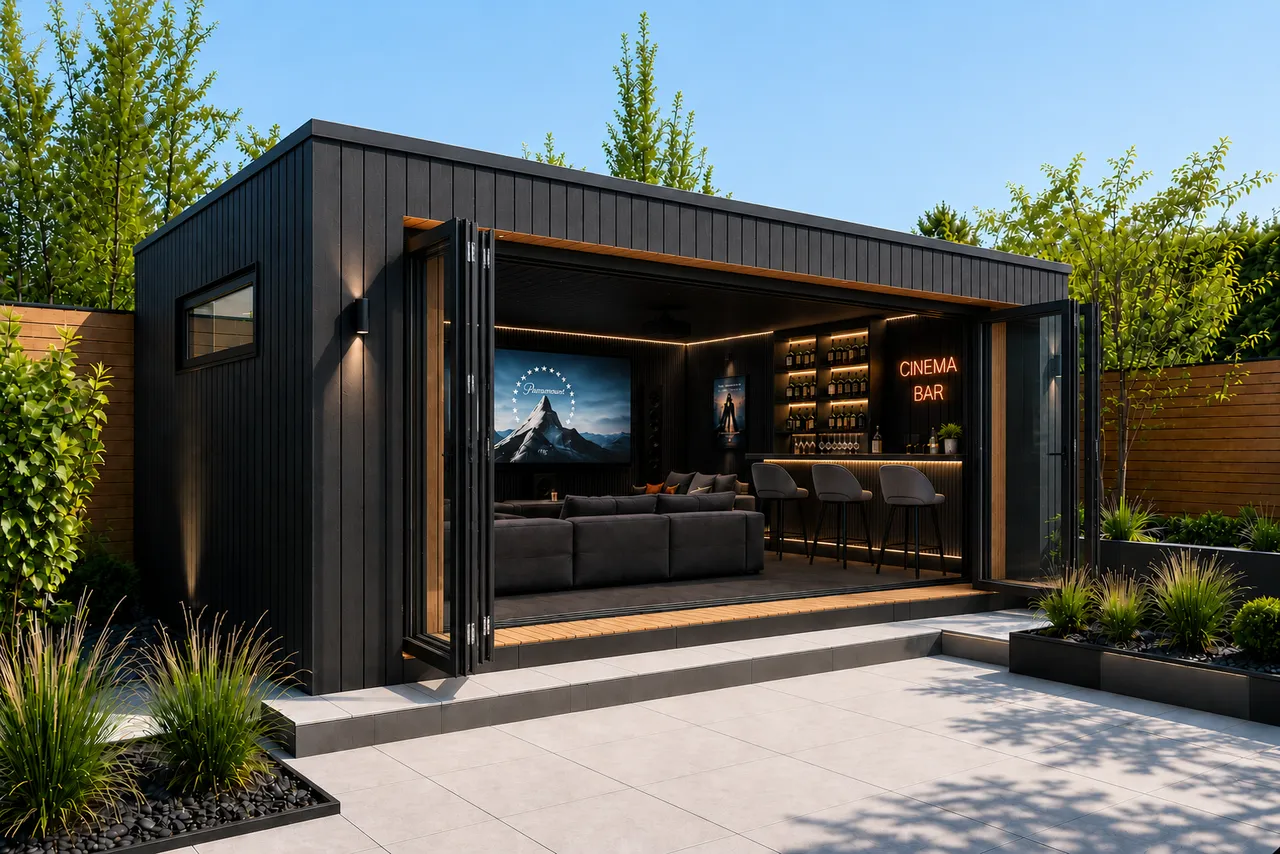
- — 01Dark cladding (charred cedar, thermo-ash, dark stained larch). Reflects less, blends more.
- — 02Dark frames (RAL 7016 anthracite grey rather than white uPVC). Same reasoning.
- — 03Low profiles. A single-storey flat or shallow-mono roof under 2.5 m sits below the tree canopy and reads as a garden building rather than an outbuilding.
The Isle of Wight
One practical note on Island installs: the Wightlink or Red Funnel freight crossing is a fixed cost we include transparently in every IoW quotation. Because the crossing is planned around tide times and freight bookings, we consolidate Island installs into scheduled routes — typically we're doing a full IoW week two or three times a year. If your timeline is flexible by a fortnight you'll usually save on delivery.
“The Sussex Downs and the New Forest look easy on Google Street View. They're some of our most detail-attentive briefs. The buildings we do best here are the ones the neighbour barely notices.”— Arden & Oak — design studio
A note on lead times
Hampshire, Sussex and IoW installs all sit inside our South-East planned-route rotation. Typical lead time from approved design to handover is 6–8 weeks. If your plot needs a National Park or AONB pre-application, add 4–6 weeks for the planning conversation — we handle the paperwork and design revisions as part of the quoted price.
Areas we cover most for this brief.
Three of the locations we build in most for the reading above. Every plot gets a site-specific spec conversation.